
A Brief Review of the History and Evolution of Men’s Shaving Cream
If you watch a lot of Westerns or epics depicting ancient civilizations, it’s easy to think of shaving as a modern practice. However, what Hollywood hasn’t admitted is that the roots of shaving may date back to prehistoric times, when shaving was performed not only performed for the sake of personal hygiene, but also for religious purposes or as the signification of a person’s status in society.
Whatever the case, one thing is true: one of the most necessary implements for men’s hair removal is shaving cream, a product whose history dates back to ancient Mesopotamia. Ready for a little more history?
Ancient as, well, beards
It is believed that the Egyptians and Mesopotamians, but specifically the Sumerians, were some of the first civilizations to have devised rudimentary men’s shaving cream. For Egyptians, shaving was necessary to maintain hygiene due to unforgiving temperatures and pests. According to the Greek historian Herodotus, they valued cleanliness greatly, even regarding it as a sign of wealth.
Historical experts believe that these ancients used a mixture of animal fats and oils to facilitate the smooth coursing of their solid gold and copper razors.
The shaving trend in Greece and Rome started with Alexander the Great, who encouraged and ordered his troops to shave to prevent the enemy from grabbing their facial hair in close combat. As a result, it soon became fashionable, and “tonsors” or barbershops became local meeting places in Rome. However, the wealthy would have their own live-in barber, and so the amount of hair on a man’s body denoted his wealth during these times.
Middle Ages
Shaving in the Middle Ages fell in and out of style based on the local lord’s preferences or religious persuasion. Nevertheless, in medieval Europe, oils and soaps were used as the main methods of shaving lubrication, while shaving tools such as copper, obsidian, and forged iron razors were used.
19th-20th century
During the 19th century, specialized shaving soaps started to emerge, such as Vroom, Fowler’s Walnut Oil, and Military Shaving soap, whose moisture retaining properties made it ideal for shaving.
At this time, shaving creams started to be marketed in tubes. By the early 20th century, the first “brushless” shaving cream, called Burma Shave, was introduced into the market. In tubes and jars, it became popular due to its convenient application and successful advertising campaigns.
It wasn’t until 1950 that the first pressurized shaving creams donned the store shelves to quickly take the reins as the preferred product over creams in cans and tubes. However, they fell out of favor by the early 1980s due to ozone depletion linked to aerosols.
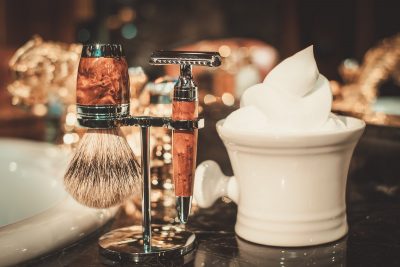
Nowadays, many men are returning to traditional wet-shaving, which involves the use of creams and soaps. Shaving creams today not only ensure an effective and pleasant shaving experience, but also keep the skin from deteriorating like a Roman ruin.
Sources:
The Evolution of Shaving Creams, Sharpologist.com
A Nick in Time: How Shaving Evolved Over 100,000 Years of History, Gizmodo.com






Leave a Reply